> For the complete documentation index, see [llms.txt](https://docs.upsmith.app/llms.txt). Markdown versions of documentation pages are available by appending `.md` to page URLs; this page is available as [Markdown](https://docs.upsmith.app/atlassian-cloud/salesforce-for-confluence/user-guide/template-variables.md).
# Template Variables
Template Variables is the core functionality of the add-on. This is what sets our add-on apart from the others.
Template Variables enables the creation of customizable templates. You can use it to insert dynamic values into the query. Users simply fill in the gaps, making complex queries straightforward.
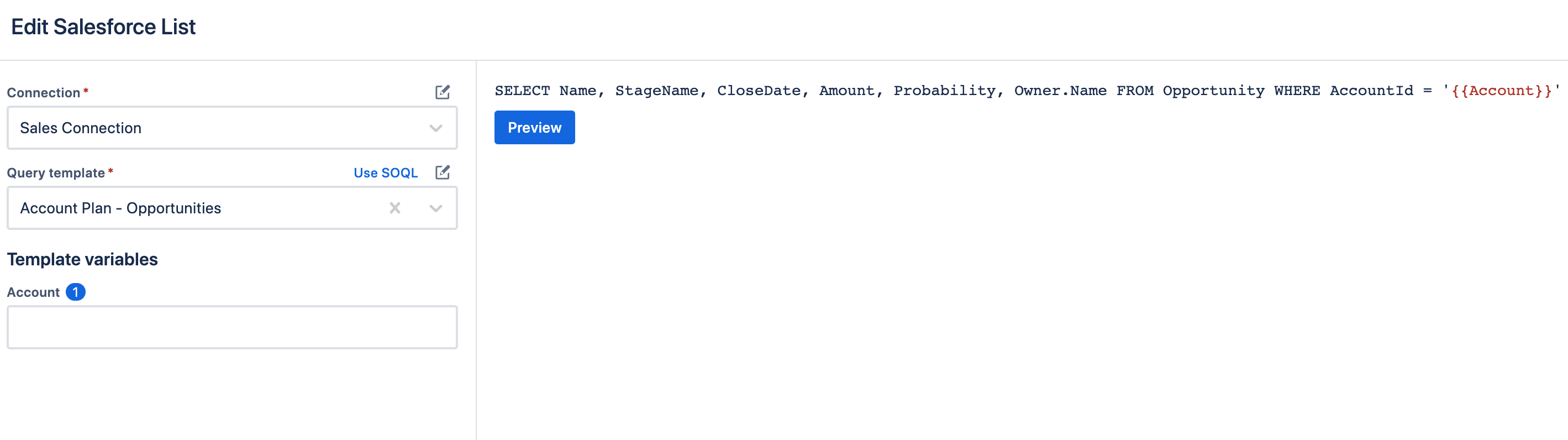
In the image above, a Query Template is defined to find Opportunities based on the matching AccountId. Notice the template variable **{{Account}}**.
You can use the defined template in SOQL List Macro.
Users utilizing this template simply need to input Account value.
Template Variables allow the same Query Template to be reused across different situations.
Account Opportunities Template used for Account #1
Account Opportunities Template used for Account #2
### Syncing Template Variable value across multiple macros
Beyond this, Template Variables enables integration between Salesforce Object and Salesforce List macros, making data handling more flexible and efficient.
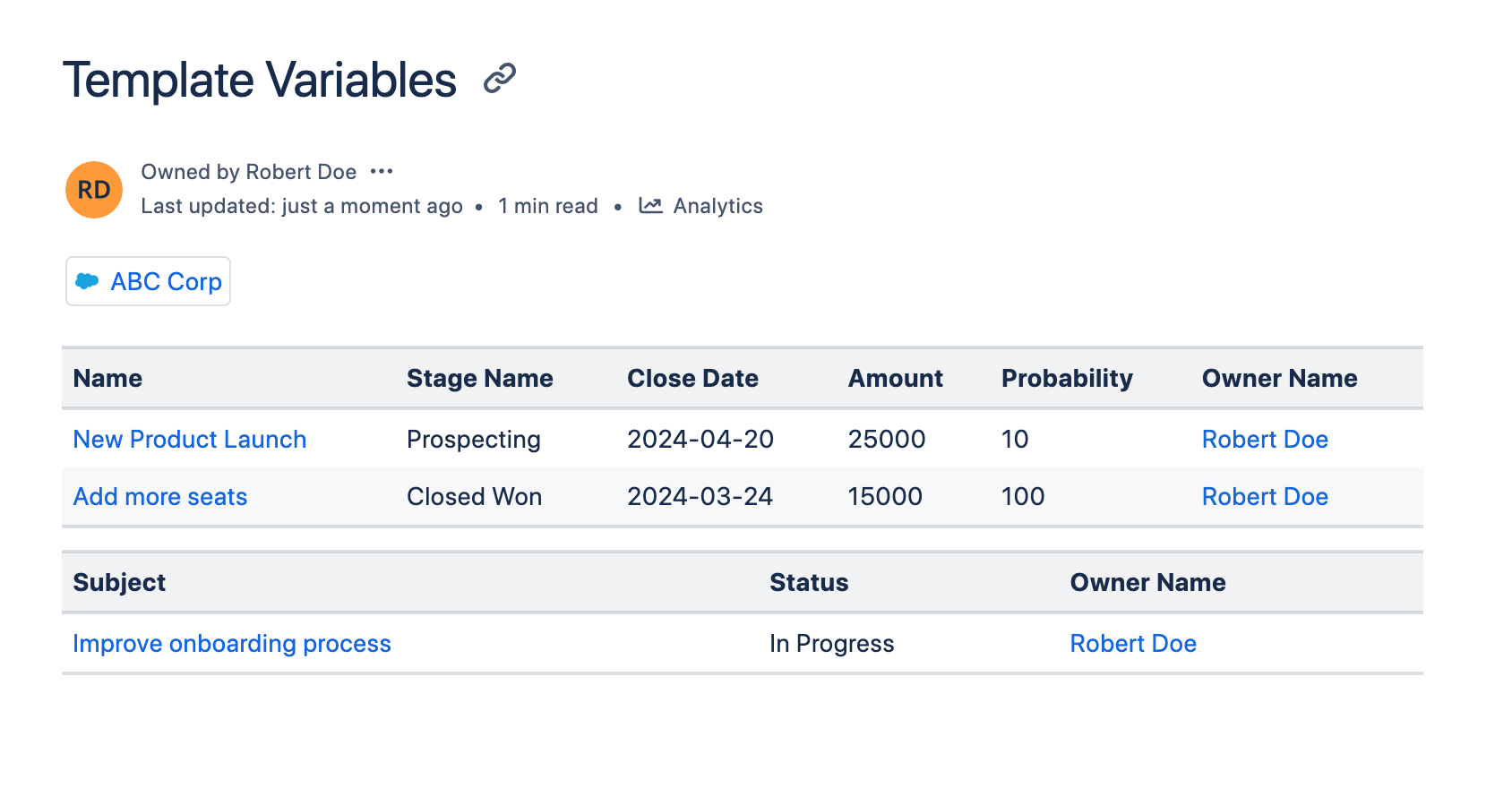
In the example below, two Salesforce List macros are added on the same Confluence page.
Both of them require the value of **Account** to be filled. When **Account** value is updated on one macro, the value of the same variable will be updated on the other macro as well.
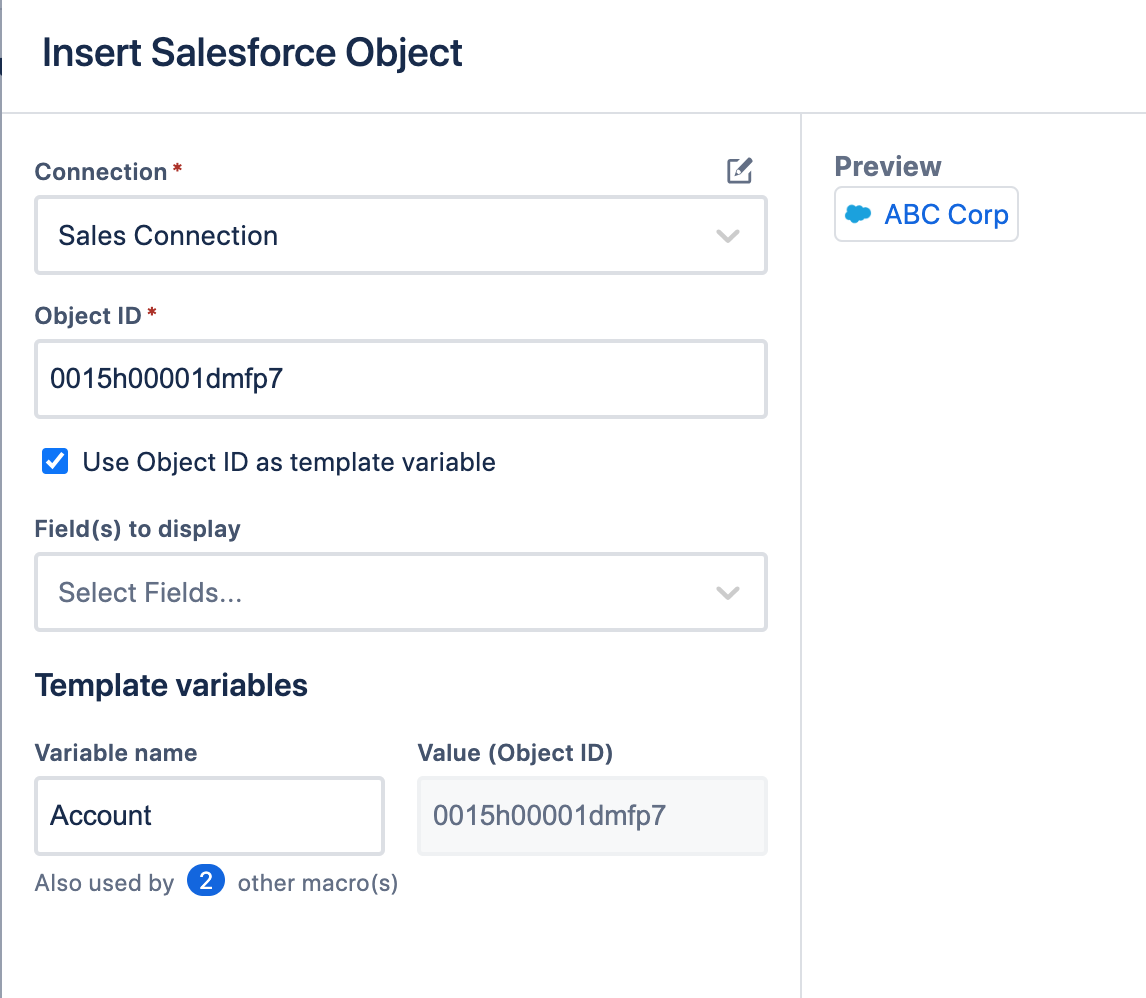
In addition, you can link both macros to a Salesforce Object macro.
Select the option to **use Object ID as a template variable** when defining Salesforce Object Macro. Enter **Account** for variable name.
{% hint style="info" %}
To link variable in Salesforce List and Salesforce Object macro, the variable must have the **same** name
{% endhint %}
The AccountId values needed for the two lists will be automatically filled using the value from Salesforce Object Macro.
Template Variables allows you to tailor complex Salesforce process to reusable template.
The possibilities are endless!